
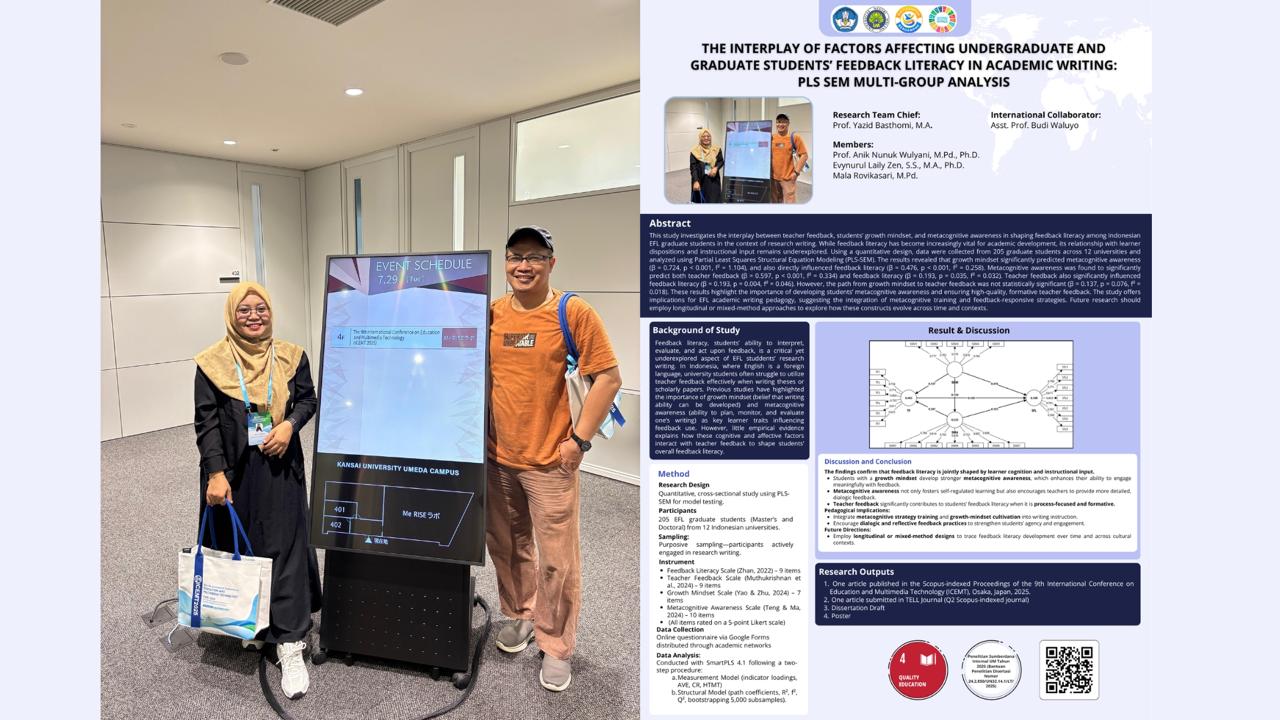
In the academic world, feedback is often seen as just a lecturer’s comments in the margins of a paper or revision notes on a student’s document. However, groundbreaking doctoral research from Universitas Negeri Malang (UM) in Indonesia reveals that feedback plays a far more profound role: it is not merely about language correction, but a dialogic process that helps students grow into reflective and independent academic writers.
The research, conducted under the supervision of Prof. Yazid Basthomi, Prof. Anik Nunuk Wulyani, and Evynurul Laily Zen, Ph.D., involved a collaboration with Asst. Prof. Budi Waluyo from Walailak University, Thailand, and UM doctoral student Mala Rovikasari. It yielded crucial findings on the feedback literacy of Indonesian students. A key output of this study, a paper titled “Unpacking Students’ Feedback Literacy in Research Writing,” was presented and published in the Proceedings of The 9th International Conference on Education and Multimedia Technology in Osaka, Japan, on July 30, 2025.
From Correction to Collaboration: Feedback as a Learning Dialogue
Traditionally, many students view lecturer feedback as a final judgment. In contrast, this study, which involved over 205 master’s and doctoral students from various Indonesian universities, shows the opposite: feedback is a highly effective learning tool.
“Students with a growth mindset and high metacognitive awareness tend to be more open to criticism and able to make more meaningful revisions,” said Yazid Basthomi, a professor at UM’s Faculty of Letters. He explained that a positive mindset prevents students from becoming defensive when receiving comments, instead allowing them to see feedback as an opportunity to learn and improve.
Using Partial Least Squares Structural Equation Modeling (PLS-SEM), the research also found that the belief that writing ability can be improved through practice is a key factor in successfully interpreting and utilizing feedback. Students with this mindset are more reflective, actively review their own writing, and collaborate effectively during the revision process.
Implications for Higher Education: Building Feedback Literacy from the Start
These findings offer a new perspective for academic mentoring practices in universities. Feedback should not stop at corrections or comments but should be directed toward building metacognitive awareness and writing independence. “Lecturers need to help students understand the reasoning behind suggested revisions and the strategies for implementing improvements,” added Prof. Yazid.
For students, this research serves as an important reminder that academic writing is not about instant results, but about the process of thinking, listening, evaluating, and refining. In today’s digital age, where artificial intelligence (AI) tools like ChatGPT and Grammarly are increasingly used, the ability to assess and manage feedback has become an essential skill.
Contributing to National Academic Literacy
This research strengthens academic mentoring practices in Indonesia, particularly in the context of writing theses, dissertations, and scientific publications. Through its international recognition, the study reinforces UM’s role as a leading higher education research center focused on developing academic literacy and preparing students for global challenges in the AI era.
As concluded in the research report, students’ success in academic writing is determined not only by their language skills but also by their ability to think reflectively, collaborate in the feedback process, and build their identity as resilient academic writers.
Readers seeking more details and the latest updates on this research can visit our official media partners kapanlagi.com and fimela.com for further info.
Leave a Reply