
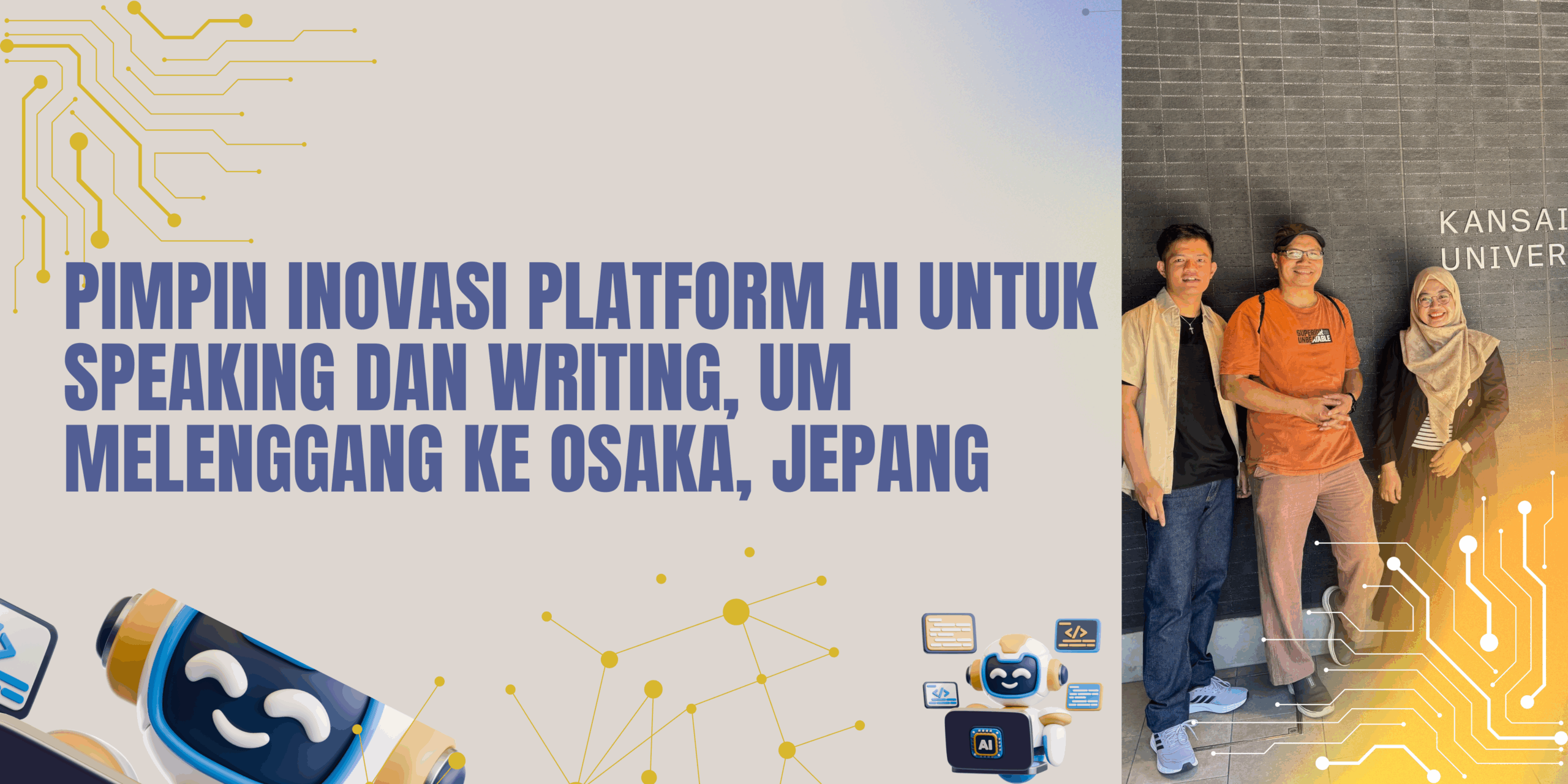
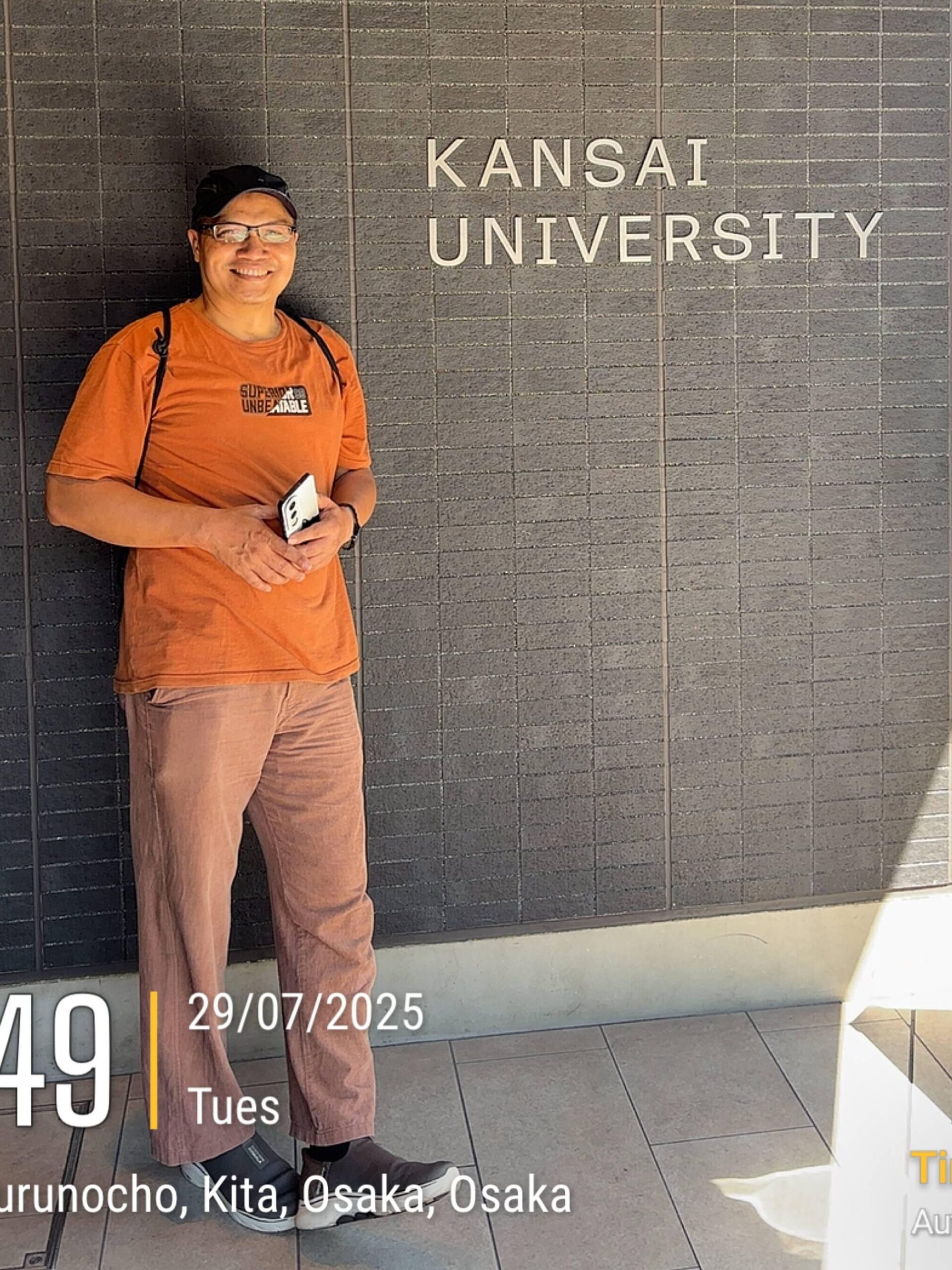
Malang – Universitas Negeri Malang (UM) has once again demonstrated its leadership in artificial intelligence (AI)-based educational research. Coordinated by Prof. Yazid Basthomi as the principal researcher, the team successfully secured five internal UM grants across various schemes. These consisted of 1 Community Service grant, 3 doctoral dissertation research grants, 1 Field of Expertise Group (KBK) research grant, and 1 matching fund research grant. Notably, two of these research projects – the matching fund project on AI and English speaking skills in collaboration with Universitas Brawijaya (UB) through Prof. Zuliati Rohmah, and the KBK research on an AI platform for academic writing – were presented at The 9th International Conference on Education and Multimedia Technology (ICEMT) 2025 in Osaka, Japan. Prof. Basthomi was accompanied by three of his doctoral students: Mala Rovikasari, M.Pd., Falentinus Ndruru, S.Pd., M.Li., and Sri Wahyuningsih, M.Pd.
When asked what made this series of research projects worthy of an international platform, Prof. Yazid Basthomi stated, “We hope that UM will not only conduct research but also design digital solutions that directly address the needs of English as a Foreign Language (EFL) learners in Indonesia, both in speaking skills and academic writing, by leveraging AI, gamification, and a needs-based approach.” He added, “With the digital platform we are designing, the hope is for UM to become a pioneer in integrating AI into the English language learning process, a model that can be adopted by various universities and learners across Indonesia.”
Two Paths, One Vision: AI-Based Speaking and Academic Writing
The first research project, titled “Needs Analysis in Designing a Multimodal Gamified AI-Integrated Platform for Enhancing EFL Students’ Speaking Skills and Self-Regulated Learning,” involved UM researchers and international collaborator Carolin Fuchs from Northeastern University, USA, as well as a matching fund collaboration with UB through Prof. Zuliati Rohmah. This study identified the real needs of students in learning speaking: difficulties maintaining fluency, the need for immediate feedback, anxiety when speaking, and the desire to practice in a safe, interactive digital environment. “Therefore, the platform being developed is directed to have AI features for real-time feedback, conversation simulations, level-based challenges, and learning progress tracking – exactly what students expect,” explained Prof. Yazid.
In line with this, the KBK scheme project on “Designing an AI-Integrated Academic Writing Platform for Enhancing EFL Students’ Writing Self-Efficacy and Metacognitive Awareness: A Needs Analysis” highlights another equally important issue in English learning: many students can write but lack confidence in their writing and have weak metacognitive awareness when composing academic texts. Through a survey of dozens of UM students, the research team found they need an academic writing platform that not only corrects grammar but also explains the reasons for corrections, helps structure arguments, provides writing prompts, offers progress reports, and facilitates writing reflection. “This is where AI is positioned not as a ‘writing machine,’ but as an educational academic assistant,” concluded the Professor.
Cross-Campus and Cross-Country Collaboration
A distinctive feature of both research projects is their collaborative nature. For the AI-based speaking project, UM did not work alone but invited Universitas Brawijaya through Prof. Zuliati Rohmah as a research member under the matching fund scheme. Simultaneously, both projects also partnered with Carolin Fuchs from Northeastern University, renowned in the field of language learning technology. Consequently, the research products being developed by UM are not only relevant for local students but are also aligned with global discussions on AI literacy, feedback literacy, and learner autonomy in the English language learning process.
The involvement of several doctoral students, including Mala Rovikasari and Sri Wahyuningsih, in presenting the results of dissertation grant research at an international dissemination forum also demonstrates UM’s research development model, which is research group-based. In this model, senior lecturers drive the main research, and doctoral students become co-researchers, with the outcomes elevated to Scopus-indexed proceedings.
Addressing the Challenges of the AI Era in Indonesian Higher Education
In both the realms of speaking proficiency and academic writing, the findings of both studies point to one conclusion: students are actually ready to learn with AI, provided the design is based on their needs. The students described needing feedback that is quick, explanations that are easy to understand, a user-friendly interface, and space for independent learning. These needs, identified through research, have directly informed the platform design, which is:
- Adaptive to students’ proficiency levels.
- Rich in reflection features and progress review processes.
- Integrated with gamification elements to make learning engaging.
- Grounded in academic principles to prevent over-reliance on AI.
In other words, this research not only enriches UM’s scientific publications but also provides a model for how Indonesian universities can develop pedagogically sound, contextual, and ethically conscious AI-based educational technology.
The success of presenting these two research projects at the international conference in Osaka, Japan, solidifies UM’s position as a university seriously committed to developing AI-based language learning. If the platform development continues to the implementation and wider testing phases, it is highly possible that UM will have its own digital product usable across campuses, serving as a testament that internal grant funding can indeed produce world-class outputs when managed through collaborative research, as exemplified by the leadership of Prof. Yazid Basthomi.
Readers who wish to read more on this subject can visit our official media partners, kapanlagi.com and fimela.com for further updates and info.
Leave a Reply