Author: admin

  • UM and Walailak University Target Q1 Scopus Journals Through EQUITY-LPDP Joint Supervision Scheme

    UM and Walailak University Target Q1 Scopus Journals Through EQUITY-LPDP Joint Supervision Scheme

    An LPDP affirmative programme pairing Indonesian promoters with cross-border co-promoters to accelerate doctoral publication in top-tier indexed journals.

    MALANG — Universitas Negeri Malang (UM) has partnered with Walailak University, Thailand, in a Joint Supervision programme funded by the Indonesia Endowment Fund for Education (LPDP) under the EQUITY scheme. The series of activities was held at UM’s Faculty of Letters from 22 to 25 April 2026, with the principal aim of accelerating doctoral publication in journals indexed in the first quartile (Q1) of Scopus.

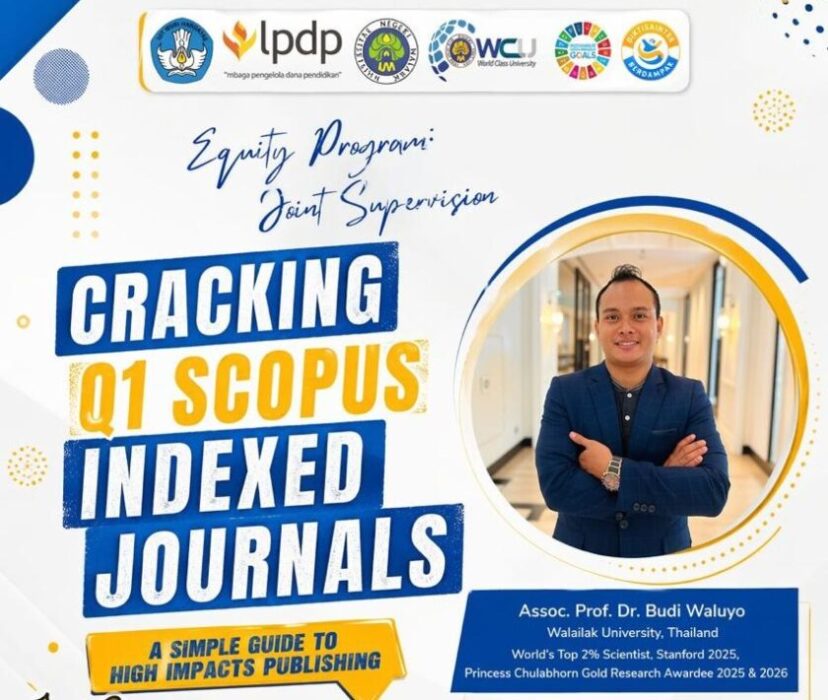
    EQUITY-LPDP is an affirmative programme designed by LPDP in collaboration with the Ministry of Higher Education, Science, and Technology to strengthen the quality of doctoral research. The scheme places Indonesian promoters and co-promoters from partner universities abroad within a single co-supervisory framework. For this round, the visiting co-promoter was Assoc. Prof. Dr. Budi Waluyo of the School of Languages and General Education, Walailak University—a scholar listed among the World’s Top 2% Scientists 2025 by Stanford University and recipient of the Princess Chulabhorn Gold Research Awardee 2025 & 2026.

    The activities opened with a closed-door discussion involving the UM promoter team, Prof. Yazid Basthomi and Dr. Evynurul Laili. The forum served both to align the direction of the ongoing doctoral research and to set the starting point for the publication strategy.

    Dissecting the Anatomy of a Q1 Manuscript

    The main agenda took place on 23 April 2026 in a workshop entitled “Cracking Q1 Scopus Indexed Journals: A Simple Guide to High Impacts Publishing”. The session was attended by lecturers, postgraduate students, and doctoral candidates within UM’s Faculty of Letters.

    For more than three hours, participants were guided through the logic of journal quartile rankings, the expectations of editors at reputable journals, and the anatomy of manuscripts that stand a chance of clearing peer review. The presenter underscored that the high rejection rate at Q1 journals largely stems from avoidable mistakes: weak novelty, mismatch between the topic and the journal’s scope, shallow theoretical framing, and failure to follow author guidelines.

    Strategy is just as important as the quality of the research itself,” Budi Waluyo emphasised during his session.

    The workshop then unpacked manuscript structure in detail: an introduction that builds urgency within 500–700 words; a literature review organised by themes and debates rather than article-by-article summaries; a transparent methodology; and a discussion section which, according to the presenter, “is most often where a manuscript falls apart“. Participants were also coached on how to respond to reviewer comments professionally—a skill rarely taught formally in doctoral programmes yet decisive for a manuscript’s fate.

    Feedback Literacy: From the Doctoral Classroom to International Publication

    Beyond the public forum, the programme also featured intensive supervision sessions for the awardee from UM’s English Language Education doctoral programme, Mala Rovikasari. In these closed sessions, the theoretical framework, methodological design, and publication plan were examined closely with the promoter and co-promoter team.

    The doctoral research developed under this programme explores the area of students’ feedback literacy in research writing—a study of how students develop the capacity to interpret, manage, and act on feedback in the process of academic writing. The topic occupies a relatively underexplored niche, in part because feedback has long been positioned as something produced by lecturers rather than as a competence that students themselves must cultivate. Yet the ability to interpret and strategically act on feedback is among the strongest predictors of academic success at the postgraduate level.

    The implications of the research operate at multiple levels. At the micro level, the findings are expected to inform supervisory practice, encouraging supervisors to move beyond the act of correction and to deliberately build students’ capacity to read and use feedback. At the institutional level, the results may inform the design of academic writing support programmes for doctoral students. At the policy level, the study opens a discussion on the need to integrate feedback literacy as a formal competence within the academic writing curriculum. The Southeast Asian context, still underrepresented in the global literature, will serve as one of the points of novelty positioned as an entry point into high-impact journals.

    Contribution to the SDGs

    The programme intersects with two agendas of the Sustainable Development Goals. SDG 4—Quality Education is reflected in efforts to build a higher education ecosystem that nurtures more autonomous postgraduate learners. SDG 17—Partnerships for the Goals, in turn, is realised through the South–South partnership pattern between UM and Walailak University, which opens a route to research internationalisation that does not always have to rely on partnerships with Western universities.

    The Way Forward

    As a mandatory output of the EQUITY-LPDP programme, the awardee and the supervisory team are working towards completing and submitting a manuscript to a Q1 Scopus journal in the field of language education or higher education. The collaboration between UM and Walailak University is also expected to extend beyond a single supervisory cycle and to develop into a longer-term research network involving lecturers and students from both institutions.

    You do not need to be a perfect scholar to publish in a Q1 journal, but you do need to be a strategic, persistent, and reflective one,” Budi Waluyo said in closing the workshop.

    Keywords: EQUITY-LPDP, Joint Supervision, Universitas Negeri Malang, Walailak University, Q1 Scopus, Feedback Literacy, SDG 4, SDG 17, Research Internationalisation.
  • Leading AI Innovation for Speaking and Writing, UM Steps onto the World Stage in Osaka, Japan

    Leading AI Innovation for Speaking and Writing, UM Steps onto the World Stage in Osaka, Japan

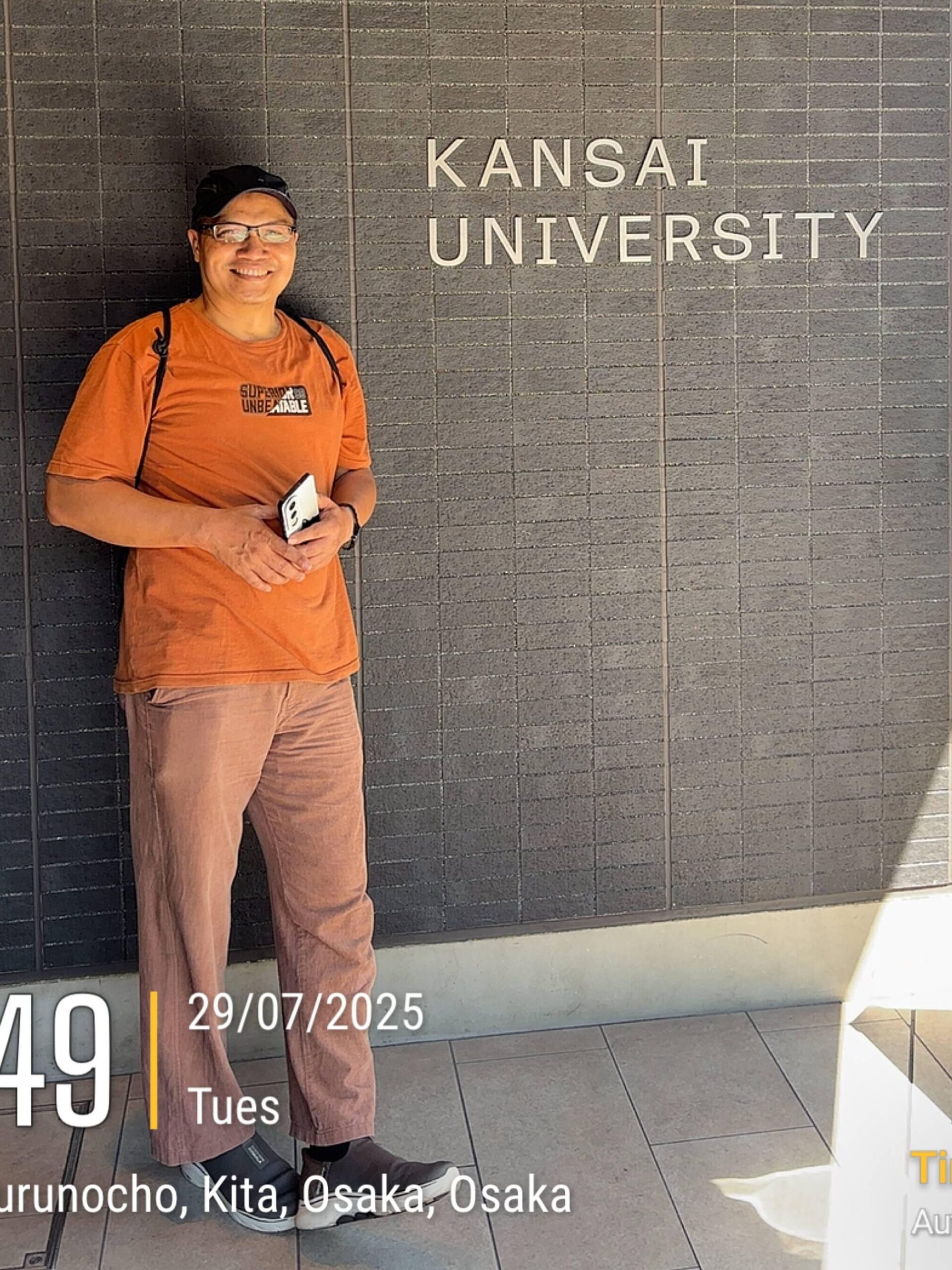
    Malang – Universitas Negeri Malang (UM) has once again demonstrated its leadership in artificial intelligence (AI)-based educational research. Coordinated by Prof. Yazid Basthomi as the principal researcher, the team successfully secured five internal UM grants across various schemes. These consisted of 1 Community Service grant, 3 doctoral dissertation research grants, 1 Field of Expertise Group (KBK) research grant, and 1 matching fund research grant. Notably, two of these research projects – the matching fund project on AI and English speaking skills in collaboration with Universitas Brawijaya (UB) through Prof. Zuliati Rohmah, and the KBK research on an AI platform for academic writing – were presented at The 9th International Conference on Education and Multimedia Technology (ICEMT) 2025 in Osaka, Japan. Prof. Basthomi was accompanied by three of his doctoral students: Mala Rovikasari, M.Pd., Falentinus Ndruru, S.Pd., M.Li., and Sri Wahyuningsih, M.Pd.

    When asked what made this series of research projects worthy of an international platform, Prof. Yazid Basthomi stated, “We hope that UM will not only conduct research but also design digital solutions that directly address the needs of English as a Foreign Language (EFL) learners in Indonesia, both in speaking skills and academic writing, by leveraging AI, gamification, and a needs-based approach.” He added, “With the digital platform we are designing, the hope is for UM to become a pioneer in integrating AI into the English language learning process, a model that can be adopted by various universities and learners across Indonesia.”

    Two Paths, One Vision: AI-Based Speaking and Academic Writing

    The first research project, titled “Needs Analysis in Designing a Multimodal Gamified AI-Integrated Platform for Enhancing EFL Students’ Speaking Skills and Self-Regulated Learning,” involved UM researchers and international collaborator Carolin Fuchs from Northeastern University, USA, as well as a matching fund collaboration with UB through Prof. Zuliati Rohmah. This study identified the real needs of students in learning speaking: difficulties maintaining fluency, the need for immediate feedback, anxiety when speaking, and the desire to practice in a safe, interactive digital environment. “Therefore, the platform being developed is directed to have AI features for real-time feedback, conversation simulations, level-based challenges, and learning progress tracking – exactly what students expect,” explained Prof. Yazid.

    In line with this, the KBK scheme project on “Designing an AI-Integrated Academic Writing Platform for Enhancing EFL Students’ Writing Self-Efficacy and Metacognitive Awareness: A Needs Analysis” highlights another equally important issue in English learning: many students can write but lack confidence in their writing and have weak metacognitive awareness when composing academic texts. Through a survey of dozens of UM students, the research team found they need an academic writing platform that not only corrects grammar but also explains the reasons for corrections, helps structure arguments, provides writing prompts, offers progress reports, and facilitates writing reflection. “This is where AI is positioned not as a ‘writing machine,’ but as an educational academic assistant,” concluded the Professor.

    Cross-Campus and Cross-Country Collaboration

    A distinctive feature of both research projects is their collaborative nature. For the AI-based speaking project, UM did not work alone but invited Universitas Brawijaya through Prof. Zuliati Rohmah as a research member under the matching fund scheme. Simultaneously, both projects also partnered with Carolin Fuchs from Northeastern University, renowned in the field of language learning technology. Consequently, the research products being developed by UM are not only relevant for local students but are also aligned with global discussions on AI literacy, feedback literacy, and learner autonomy in the English language learning process.

    The involvement of several doctoral students, including Mala Rovikasari and Sri Wahyuningsih, in presenting the results of dissertation grant research at an international dissemination forum also demonstrates UM’s research development model, which is research group-based. In this model, senior lecturers drive the main research, and doctoral students become co-researchers, with the outcomes elevated to Scopus-indexed proceedings.

    Addressing the Challenges of the AI Era in Indonesian Higher Education

    In both the realms of speaking proficiency and academic writing, the findings of both studies point to one conclusion: students are actually ready to learn with AI, provided the design is based on their needs. The students described needing feedback that is quick, explanations that are easy to understand, a user-friendly interface, and space for independent learning. These needs, identified through research, have directly informed the platform design, which is:

    • Adaptive to students’ proficiency levels.
    • Rich in reflection features and progress review processes.
    • Integrated with gamification elements to make learning engaging.
    • Grounded in academic principles to prevent over-reliance on AI.

    In other words, this research not only enriches UM’s scientific publications but also provides a model for how Indonesian universities can develop pedagogically sound, contextual, and ethically conscious AI-based educational technology.

    The success of presenting these two research projects at the international conference in Osaka, Japan, solidifies UM’s position as a university seriously committed to developing AI-based language learning. If the platform development continues to the implementation and wider testing phases, it is highly possible that UM will have its own digital product usable across campuses, serving as a testament that internal grant funding can indeed produce world-class outputs when managed through collaborative research, as exemplified by the leadership of Prof. Yazid Basthomi.

    Readers who wish to read more on this subject can visit our official media partners, kapanlagi.com and fimela.com for further updates and info.

  • Rethinking Feedback: Doctoral Research from UM Reveals the Key to Student Success in Academic Writing in the AI Era

    Rethinking Feedback: Doctoral Research from UM Reveals the Key to Student Success in Academic Writing in the AI Era

    In the academic world, feedback is often seen as just a lecturer’s comments in the margins of a paper or revision notes on a student’s document. However, groundbreaking doctoral research from Universitas Negeri Malang (UM) in Indonesia reveals that feedback plays a far more profound role: it is not merely about language correction, but a dialogic process that helps students grow into reflective and independent academic writers.

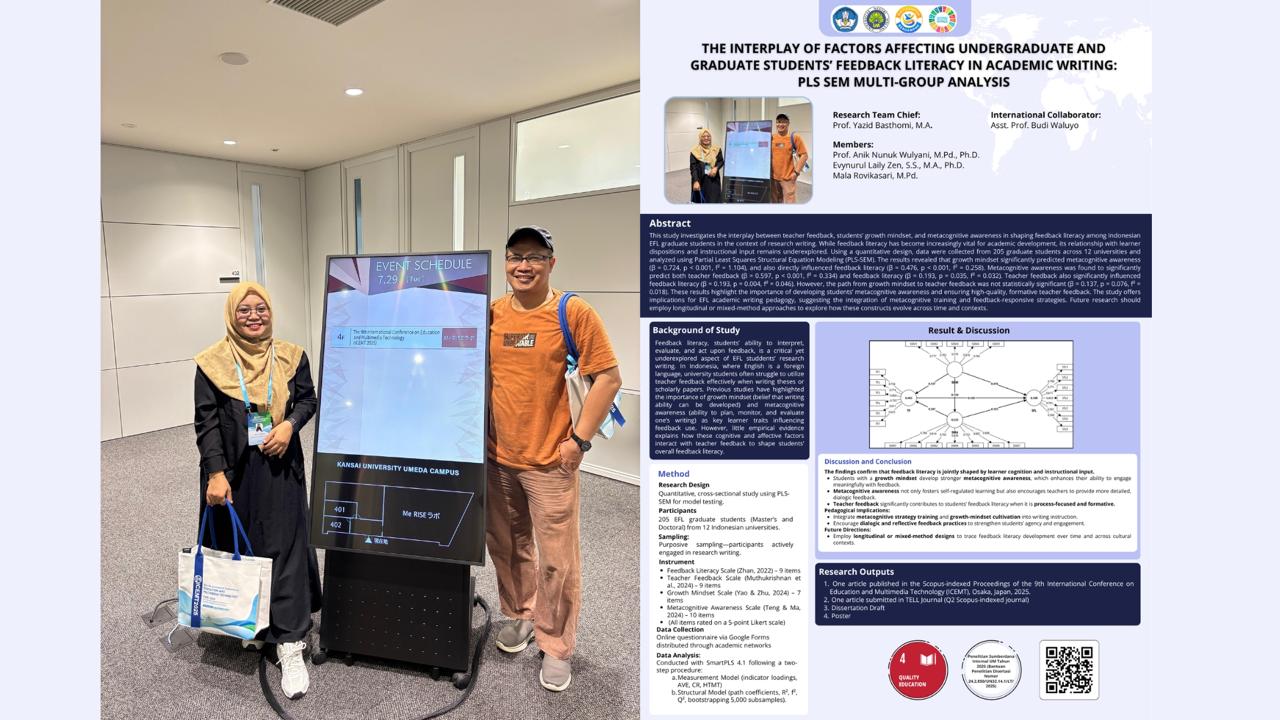
    The research, conducted under the supervision of Prof. Yazid Basthomi, Prof. Anik Nunuk Wulyani, and Evynurul Laily Zen, Ph.D., involved a collaboration with Asst. Prof. Budi Waluyo from Walailak University, Thailand, and UM doctoral student Mala Rovikasari. It yielded crucial findings on the feedback literacy of Indonesian students. A key output of this study, a paper titled “Unpacking Students’ Feedback Literacy in Research Writing,” was presented and published in the Proceedings of The 9th International Conference on Education and Multimedia Technology in Osaka, Japan, on July 30, 2025.

    From Correction to Collaboration: Feedback as a Learning Dialogue

    Traditionally, many students view lecturer feedback as a final judgment. In contrast, this study, which involved over 205 master’s and doctoral students from various Indonesian universities, shows the opposite: feedback is a highly effective learning tool.

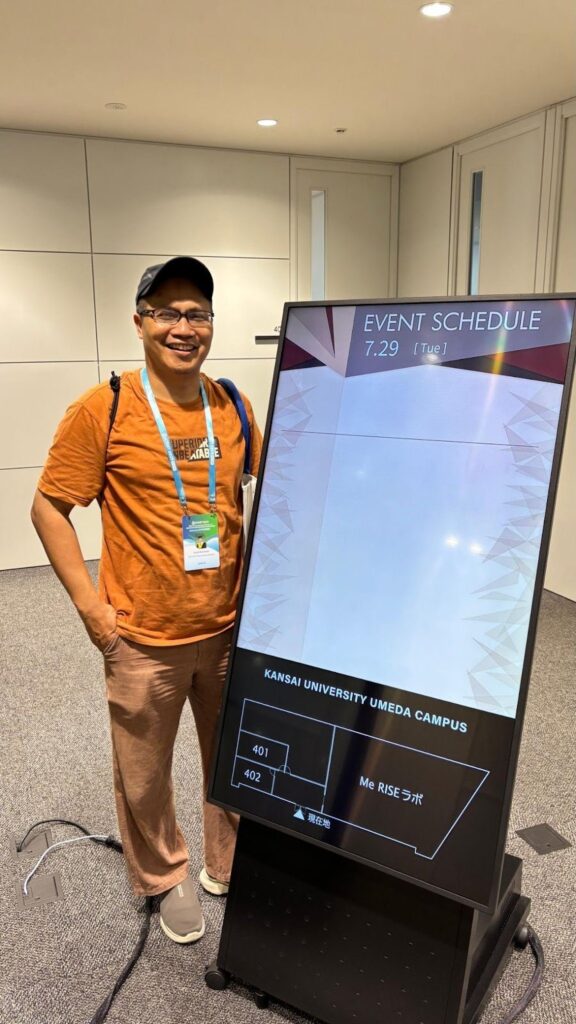
    Prof. Yazid Basthomi attending the Osaka Conference

    “Students with a growth mindset and high metacognitive awareness tend to be more open to criticism and able to make more meaningful revisions,” said Yazid Basthomi, a professor at UM’s Faculty of Letters. He explained that a positive mindset prevents students from becoming defensive when receiving comments, instead allowing them to see feedback as an opportunity to learn and improve.

    Using Partial Least Squares Structural Equation Modeling (PLS-SEM), the research also found that the belief that writing ability can be improved through practice is a key factor in successfully interpreting and utilizing feedback. Students with this mindset are more reflective, actively review their own writing, and collaborate effectively during the revision process.

    Implications for Higher Education: Building Feedback Literacy from the Start

    These findings offer a new perspective for academic mentoring practices in universities. Feedback should not stop at corrections or comments but should be directed toward building metacognitive awareness and writing independence. “Lecturers need to help students understand the reasoning behind suggested revisions and the strategies for implementing improvements,” added Prof. Yazid.

    For students, this research serves as an important reminder that academic writing is not about instant results, but about the process of thinking, listening, evaluating, and refining. In today’s digital age, where artificial intelligence (AI) tools like ChatGPT and Grammarly are increasingly used, the ability to assess and manage feedback has become an essential skill.

    Contributing to National Academic Literacy

    This research strengthens academic mentoring practices in Indonesia, particularly in the context of writing theses, dissertations, and scientific publications. Through its international recognition, the study reinforces UM’s role as a leading higher education research center focused on developing academic literacy and preparing students for global challenges in the AI era.

    As concluded in the research report, students’ success in academic writing is determined not only by their language skills but also by their ability to think reflectively, collaborate in the feedback process, and build their identity as resilient academic writers.

    Readers seeking more details and the latest updates on this research can visit our official media partners kapanlagi.com and fimela.com for further info. 

  • UM Researchers Develop “Fielding Literature” Strategy to Deepen Students’ Literary Understanding

    UM Researchers Develop “Fielding Literature” Strategy to Deepen Students’ Literary Understanding

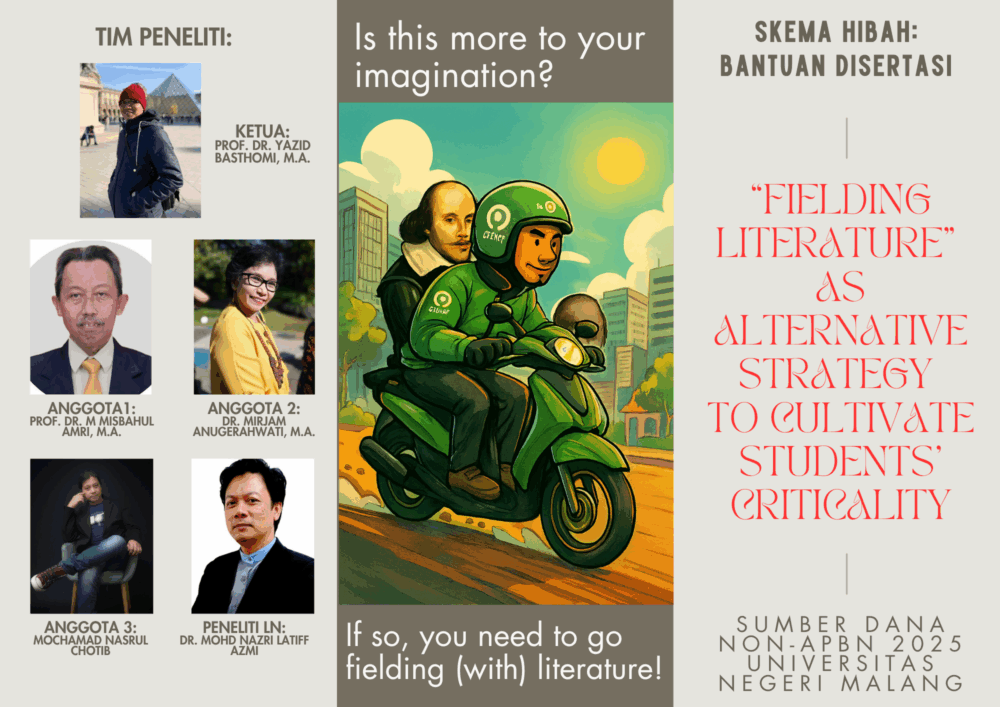
    MALANG, October 3, 2025 – A research team from Universitas Negeri Malang (UM) is pioneering an innovative learning strategy named “Fielding Literature” to tackle a common challenge in English literature classes: helping students move beyond mere translation to achieve a deeper, more critical understanding of literary works.

    The strategy is designed to bridge the cultural gap students often face when reading foreign texts. Instead of relying solely on textual analysis, “Fielding Literature” actively involves local cultural practitioners and resources, allowing students to compare and contrast the values and experiences in the literature with their own local context. This approach is grounded in Bourdieu’s field theory and Vygotsky’s sociocultural theory, emphasizing real-world, experiential learning.

    Yazid Basthomi, Professor of Applied Linguistics, Universitas Negeri Malang

    Prof. Yazid Basthomi, the lead researcher, explained the inspiration behind the study. “For over two decades of teaching, we’ve consistently observed one thing: students often try to understand a text based on language and syntax alone, as if understanding the words automatically reveals the deeper meaning,” he said.

    “In reality,” Prof. Yazid continued, “language is merely the container, not the content or the meaning. This creates a cultural discrepancy between the student and the text. For example, when a text from Shakespeare’s era says ‘I’m going to the market,’ simply knowing the Indonesian translation (“Saya berangkat ke pasar”) doesn’t provide the intended depth. Remember, there were no ride-hailing apps such as “Gojek” nor even motorcycles yet in Shakespeare’s time—so how did people get to the market? What was the market like? What was available or unavailable there? Through ‘Fielding Literature,’ we hope students can experience the implicit cultural values in a text by engaging in relevant field activities.”

    The research team is led by Prof. Yazid Basthomi and includes two faculty members from the Department of English, FS-UM, Prof. M Misbahul Amri and Dr. Mirjam Anugerahwati, a doctoral student in English Language Education, Mochamad Nasrul Chotib, and an international researcher, Dr. Mohd Nazri Latiff Azmi from Universiti Sultan Zainal Abidin, Malaysia.

    The “Fielding Literature” research is fully funded by Universitas Negeri Malang through a dissertation grant scheme for the 2025 period. For further information on this and other research projects, readers may visit the official media partners, kapanlagi.com and fimela.com.

  • UM Research Team Develops “Cakralingo,” a Digital Language Learning Platform for Teachers and Students

    UM Research Team Develops “Cakralingo,” a Digital Language Learning Platform for Teachers and Students

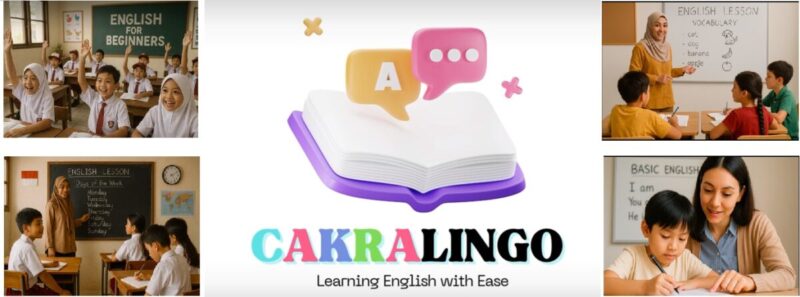
    UNIVERSITAS NEGERI MALANG, Indonesia – A research team from Universitas Negeri Malang (UM) has launched an innovative digital platform designed to revolutionize English language learning. Named “Cakralingo,” the platform is a digital language lab that serves both teachers and students across all levels of education.

    Unlike traditional learning tools, Cakralingo is built as a User-Generated Content (UGC) website, allowing users to create, share, and access a wide variety of learning materials—from text and audio to videos and app-based content.

    Cakralingo empowers its users to design, modify, and organize content based on their specific needs, themes, or difficulty levels. Thanks to its UGC model, uploading and downloading diverse materials in multiple formats is simple and intuitive.

    The project is led by Prof. Yazid Basthomi and includes team members Mochamad Nasrul Chotib, M.Hum., a lecturer from the Department of English, FS-UM, along with two doctoral students, Falentinus Ndruru and Mala Rovikasari. The research is fully funded by Universitas Negeri Malang under the 2025 Community Partnership Program (Program Kemitraan Masyarakat or PKM) and collaborates with partner schools SD My Little Island and SMP National Leader School.

    In a recent statement, Prof. Yazid emphasized the platform’s core mission: “We want Cakralingo to be more than just a ‘stop-and-go’ website. Our goal is to foster positive and sustainable engagement through learning materials created by the users, for the users.”

    Prof. Yazid Basthomi

    Cakralingo aims to build an active and supportive community by functioning as a Digital Learning Laboratory (DLL). It incorporates gamification elements such as reward points, stars, and leaderboards to make learning interactive and enjoyable. The platform is designed to help teachers and students develop their potential in three key areas:

    • Creative: Enabling users to create tailored learning materials at various levels and formats.
    • Communicative: Fostering an active user community that encourages mutual support.
    • Recreational: Using fun, game-like features that motivate without overwhelming users.

    Prof. Yazid also addresses feedback from educators: “We fully agree with the teachers who emphasized avoiding a ‘system-addict’—where users only download without contributing back to the community. Cakralingo is designed for shared growth.”

    Currently, Cakralingo is in the testing and content development phase. In the future, the platform aims to expand beyond English to include other languages, particularly the diverse local languages of Indonesia, unlocking their potential through ongoing community and academic partnerships.

    For more information on the Cakralingo platform and related research, interested readers may visit our official media partners, kapanlagi.com and fimela.com.

  • UM Launches AI Research to Help Students Write Their Theses Faster

    UM Launches AI Research to Help Students Write Their Theses Faster

    Writing a thesis or academic article in English is often a major hurdle for Indonesian students. Many struggle with the nuances of academic style, proper structure, and the writing strategies needed to meet international publication standards. These challenges frequently lead to delayed graduations and limited contributions to reputable journals.

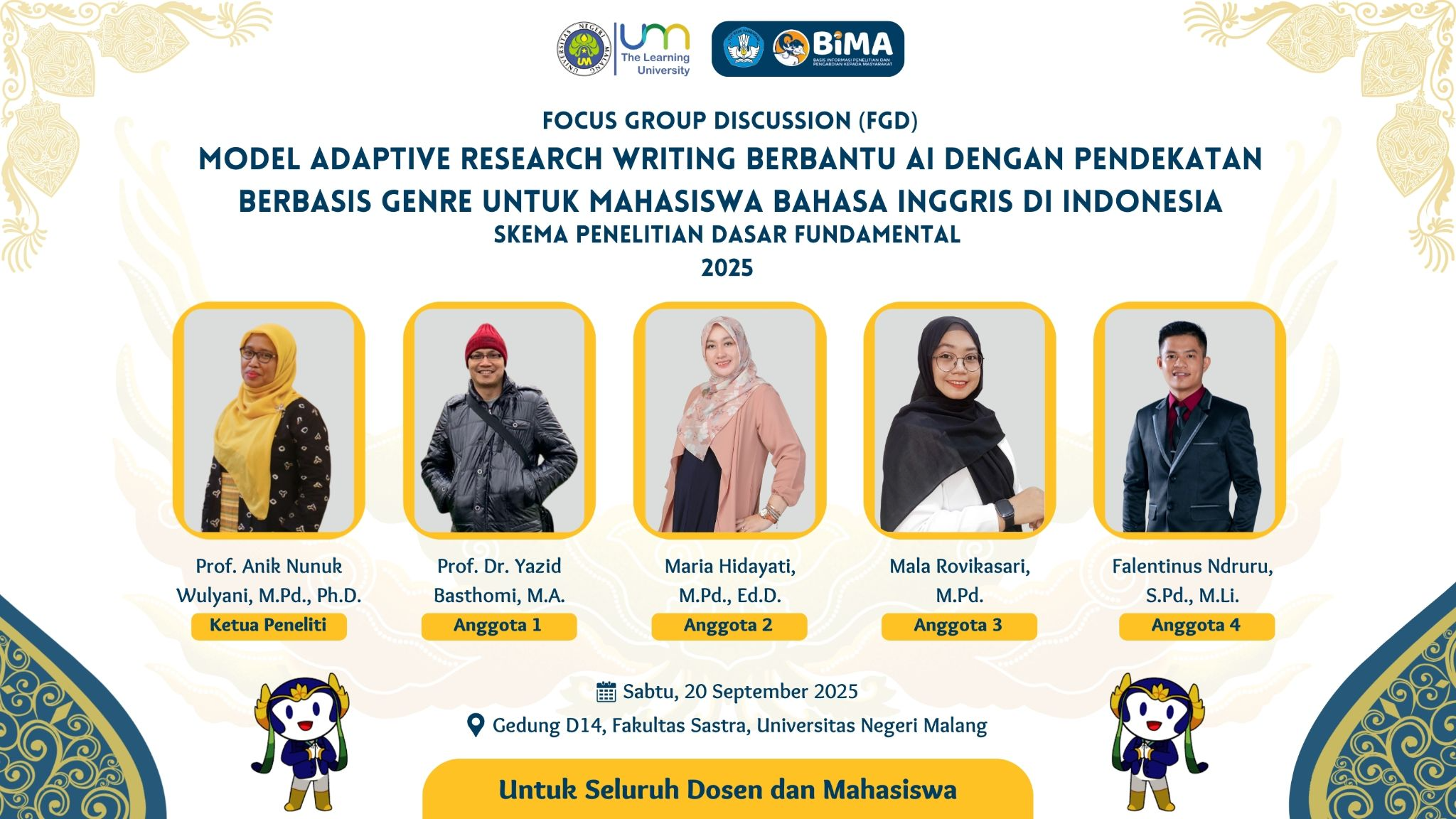
    To tackle this problem, a research team from Universitas Negeri Malang (UM) is developing an adaptive, genre-based academic writing model assisted by Artificial Intelligence (AI). The two-year project, led by Professor Anik Nunuk Wulyani, involves eight universities from across the Indonesian archipelago, from Aceh to Papua. The team full-force includes Professor Yazid Basthomi, Maria Hidayati, M.Pd., Ed.D., along with two student-members, Mala Rovikasari, M.Pd. and Falentinus Ndruru, S.Pd., M.Li.

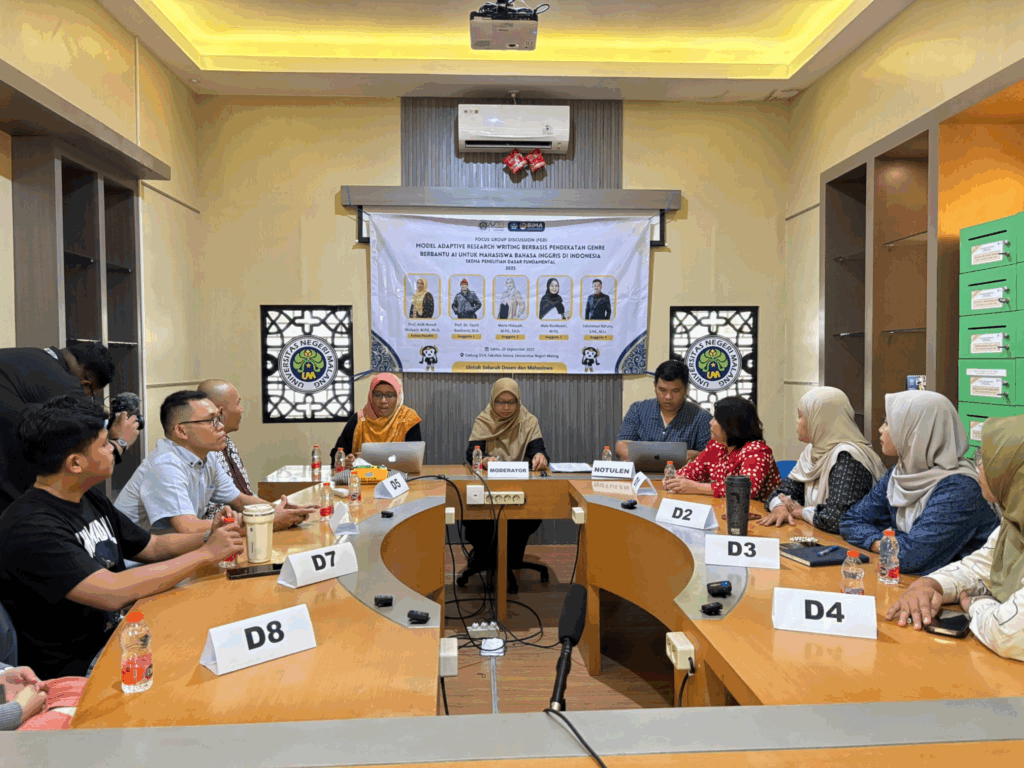
    FGD presided by Prof Wulyani (in orange kerudung) to mark the initiation of the full-scale research

    According to Prof. Wulyani, students’ biggest weakness is not just language proficiency, but also a lack of understanding of academic genres—such as how to structure a research introduction, write a literature review, or present findings. “AI enables more personalized learning. Students can receive feedback tailored to their specific weaknesses and needs. This makes the writing process more focused and effective,” she explained.

    The research, entitled An AI-Assisted, Genre-Based Adaptive Model for Research Writing in Indonesian English Language Studies, uses an Educational Design Research (EDR) approach, a method that emphasizes gradual model development: starting from needs analysis, prototype design, and expert validation, to real-world testing in classrooms. The expected outcome is an adaptive, AI-based learning model ready for widespread adoption in Indonesian higher education.

    In addition to the prototype, the team is targeting publications in reputable international journals (Scopus Q1), international conference proceedings, and a policy brief to provide input for higher education stakeholders.

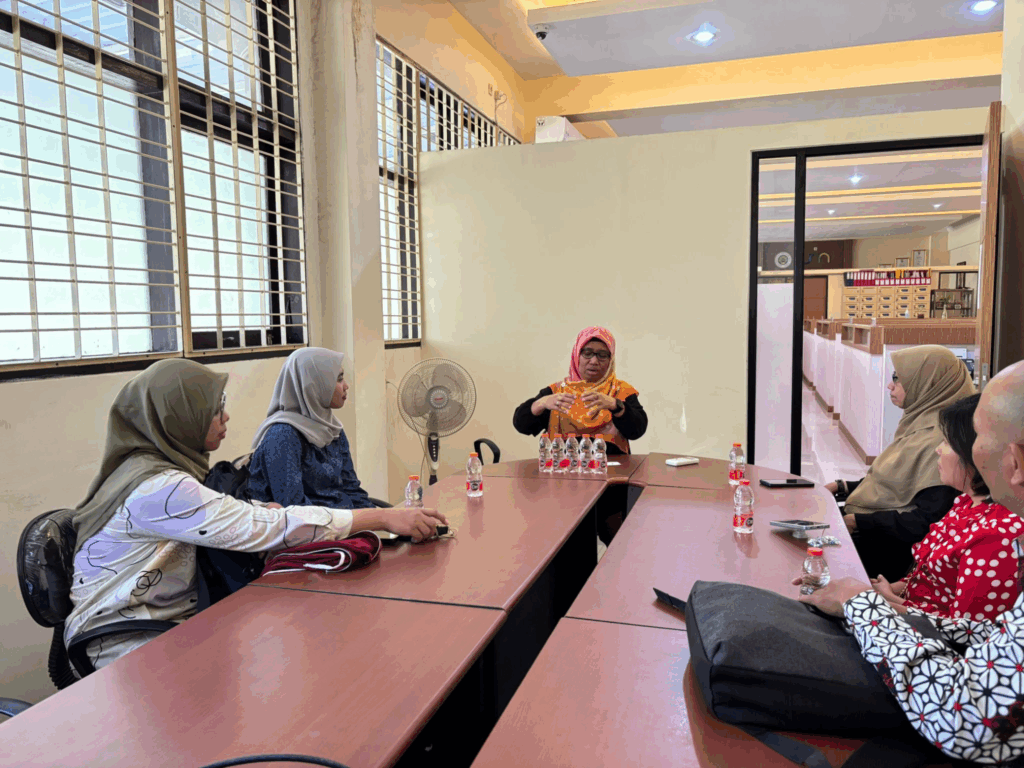
    Prof. Wulyani giving deeper insights to the participants in the FGD

    Furthermore, this initiative aligns with the Sustainable Development Goals (SDGs), specifically SDG 4 (Quality Education), SDG 9 (Industry, Innovation, and Infrastructure), and SDG 17 (Partnerships for the Goals). The cross-university collaboration is a concrete step toward building a more inclusive and innovative educational ecosystem.

    We hope this research will help students graduate on time, improve the quality of academic publications, and strengthen Indonesia’s position in the global academic arena,” added Prof. Wulyani. If successful, this model has the potential to become a breakthrough for national higher education, establishing UM as a pioneer in leveraging AI to boost Indonesia’s academic competitiveness.

    A photo session ending the FGD that also initiates the real deal of the research

    Curious readers may visit our professional and national-scale media partners at Kapanlagi and Fimela for additional information and or further updates about the research and results.

  • Be Here or Just Behind! NEELLS Invites You!

    Be Here or Just Behind! NEELLS Invites You!

    At last, one of the most prestigious seminars held and organized by the Doctoral Program of English Language Education, Department of English, Faculty of Letters is ready to launch. 

    The National English Education, Linguistics and Literature Seminar (NEELLS) 2025 is just around the corner and you all are warmly invited to participate in the event. 

    The D-day of the seminar is set on November 8th, 2025 so make sure you book the date on your smartphone’s calendar right! The seminar is held in full virtual mode bearing the current theme of Voices in A Hyper-Digital World: Dismantling English Education, Language, Literature, and Gender Studies. There are various subsequent sub-themes to suit your interests and papers’ topic, to viz:

    – English Language Pedagogy

    – Teacher Professional Development

    – Materials and Media Development

    – Linguistic development

    – Bilingualism and Multilingualism

    – Corpus Linguistics

    – Literary Criticism

    – Digital Literature

    – Gender(ed) Studies

    – Any current/emerging technologies in or innovative mixture of the above 

    With such a topic, it is only natural if NEELLS invites esteemed speakers most suitable for the occasion. The list of main presenters for the upcoming November 8th is fixed and they are: Prof. Paul Kei Matsuda, Ph.D (Linguistics) from Arizona State University, USA; Rimajon Sotlikova, Ph.D (English Education) from Webster University in Tashkent, Uzbekistan; Prof. Evi Eliyanah, Ph.D (Gender Studies) from Universitas Negeri Malang, Indonesia; Prof. Herawaty Abbas, Ph.D (English Literature) from Universitas Hasanuddin, Indonesia and last but never the least, Dr. Afif Ikhwanul M. (International Publication) from Universitas Islam Negeri Mataram, Indonesia.

    In conjunction with the seminar, our honorable Head of the Department of English, Dr. Suharyadi, M.Pd., correctly elucidated, “The theme reflects the continuous and rapid shifts in English language teaching (ELT), literary, linguistic and gender studies as we adapt to new pedagogical approaches, emerging technologies, and evolving global contexts.”  Hence within this given situation, every one of  “English language educators, scholars of literature, linguists as well as gender critics are all faced with the challenge of navigating and dismantling these changes while ensuring the preservation of quality and integrity in teaching, research, and scholarly discourse,” he critically appraised a while later. 

    And so, to all the would-be participants, our Head of the Department kindly edified, “This seminar provides us with the opportunity to explore those dynamic developments through the lens of our shared knowledge and expertise.” Thus, it is only natural that, “together, we will reflect on best practices, emerging research, and future trends that will shape the way we teach, study, and analyze language and literature,” he solemnly added. 

    NEELLS 2025 provides most benefits to students of all strata. If you are an undergraduate or graduate (taking a Magister or Doctoral program), NEELLS 2025 gives the best chance to present your ideas, papers, and or even your thoughts relevant to the said topics and sub-topics. A special mention, however, is given to candidate-presenters from undergraduate (Strata 1) degree as you may have even more benefits from the event, i.e. not only will you gain experience in joining or even speaking in a forum with international presenters, you can use the certificate of appreciation as one of your credits for extracurricular activities (or the KRE). 

    And yet, the benefits haven’t stopped that far! All of you who are eligible to present in NEELLS 2025 will have an equal chance to have your abstract or paper reviewed and recommended to publish within one of the journals in partnership with the event. But never read it wrongly though as the committee will only provide reviews and recommendation into which journals your paper is likely most suitable for. Needless to say, whether or not you accept the recommendation or the said journal accepts your article for publication, the consideration becomes each party’s absolute decision. 

    The complete list of the journals in partnership is as follows: 

    1. JETLI (SINTA 2), UIN Sunan Kudus

    2. Jurnal Iqra Kajian Ilmu Pendidikan (SINTA 2), UMALA 

    3. Lensa: Kajian Kebahasaan, Kesusastraan, dan Budaya (SINTA 2), Unmuh Semarang

    4. ELT-Lectura (SINTA 3), Universitas Lancang Kuning

    5. Anglophile Journal (SINTA 3), Creative Tugu Pena

    6. IJCEP (SINTA 3), Payungi Smart Madani 

    7. Jurnal Erudita (SINTA 4), UIN Gusdur Pekalongan

    8. JEEL (SINTA 4), STAIN Madina

    9. JOEY (SINTA 4), Universitas Ibrahimy (APC 350rb)

    10. Bulletin of Science Education (SINTA 4), Creative Tugu Pena 

    11. Bulletin of Pedagogical Research (SINTA 4), Creative Tugu Pena 

    12. Jurnal Pedagogy (SINTA 4), UIN Jurai Siwo Lampung 

    13. Jurnal Tinta (SINTA 5), Univ al-Qolam

    14. Attractive: Innovative Education Journal (SINTA 5), Creative Tugu Pena

    15. IJoASER (SINTA 5) Creative Tugu Pena

    16. Tefla (Proses Penilaian), UM Banjarmasin (for 2026 publication) 

    17. Jurnal Pembelajaran Sastra (Registered), Hiski Komisariat Malang

    Again, to think that your benefits as participants will stop so far is anything but wrong. NEELLS 2025 is teaming up with top-tier institutions to spoil attendees with irresistible freebies and exclusive giveaways. Leading the charge is Balai Bahasa UM (BB-UM), the event’s language powerhouse, which is giving away free IELTS Simulation Tests (normally priced at IDR 250,000) to 10 (ten) lucky participants. BB-UM is known as an official test center for high-stakes exams like IELTS on Computer, ITP TOEFL® (in collaboration with Jakarta’s IIEF), TKBI/TKDA (with PLTI), and even Arabic proficiency tests (ILA). Their language course catalog spans English, German, Korean, Japanese, and Mandarin, making them a one-stop shop for linguistic mastery.

    And the perks don’t stop there. Sekolah MC Malang, a trailblazer in non-formal education, is stepping up as a sponsor with 10 free one-month course vouchers focused on public speaking—a must-have skill for the 21st century. They offer rigorous programs from mastering the art of emceeing and vocal training to sharpening presentation skills and even fashion styling for hosts; they’ve just got it all. Every graduate walks away with an official competency certification, a golden ticket to stand out in the industry.

    If those two aren’t enough, also acting as NEELLS 2025’s partner is Rumah Jurnal Creative Tugu Pena, an integrated open journal system (OJS) hosting platform designed to help authors and writers with variability of available journals or to even start managing their own. The platform is already indexed with various international databases such as Cabell’s Whitelist, DOAJ, SINTA, Ulrichsweb, Proquest, Crossref, Google Scholar, etc. As a partner, Creative Tugu Pena is willing to provide free APC for 2 selected articles submitted to any one of the journals listed in the partnership. 

    So, what are you really waiting for? Submit your abstracts starting from August 20 – September 03, 2025 and be someone with something to voice critically loudly to our more and more hyper-digital world – else, just be left afar. 

    You can also visit our media partners at Kapanlagi or at Fimela for further details at any time and from anywhere you want. 

    See you at the occasion, folks!

  • NEELLS’s coming! Heads Up Folks!

    NEELLS’s coming! Heads Up Folks!

    The Doctoral Program of English Language Education, Faculty of Letters, Universitas Negeri Malang, is proudly preparing one of its most anticipated annual events, the National English Education, Language and Literature Seminar (NEELLS) 2025. 

    You will be presenting with some of the most illustrious keynote speakers with international reputation in either educational, language and or literature expertise. But wait! That’s just not all. Our one special guest is planned to enlighten all of you with the topic of preparing your papers for international publications. 

    So make sure you catch up with the updates and better start preparing your abstracts and papers right now, fellas! Your option is either be there or just behind! (if you don’t catch the catch, this event may not be for you – yet). 

    Mark your calendar, legends! And don’t forget to keep checking for news and updates on our media partners at Kapanlagi (https://plus.kapanlagi.com/nells-2025-segera-hadir-siapkan-abstrak-dan-artikel-terbaikmu-0e4684.html) and also here at Fimela (https://www.fimela.com/info/read/6123263/nells-2025-segera-hadir-siapkan-abstrak-dan-artikel-terbaikmu). 

  • Congrats Cita! That’s One Title Really Worth Fighting For

    Congrats Cita! That’s One Title Really Worth Fighting For

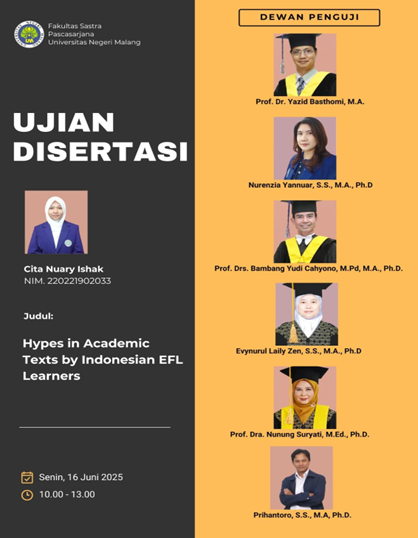
    Dear readers, our program managed to successfully deliver one more student worthy to put one of the highest academic titles in her name. Ms Cita Nuary Ishaq, or Cita for short, was able to satisfactorily defend her dissertation entitled Hypes in Academic Texts by Indonesian EFL Learners in her Ujian Disertasi on June 16, 2025.

    During her sidang, Cita was able to convince the board of examiners that trend-driven discourses might be alarming as they may create empty jargons or meaningless repetitions in scientific communications, rendering the nurturing or fostering of more authentic academic (local) voices.

    Acting as her Dewan Penguji were Prof. Dr. Yazid Basthomi, Nurenzia Yannuar, Ph.D., Evynurul Laily Zein, Ph.D., Prof. Bambang Yudi Cahyono, Ph.D., Prof. Nunung Suryati, Ph.D. and Prihantoro, Ph.D. as external examiner from Fakultas Ilmu Budaya, Universitas Diponegoro. All examiners agreed unanimously on the predicate of “dengan memuaskan” for her dissertation.

    Again, biggest kudos to Cita! May this success become an evidence of lifelong learning and start a journey of highest academic contribution to our country. If anything, you deserve it!

  • Your PDDI is Here! Make Sure to Catch It!

    Your PDDI is Here! Make Sure to Catch It!

    Hi readers, great news sure comes to you all, especially for any doctoral degree applicants in all programs and universities of Indonesia.

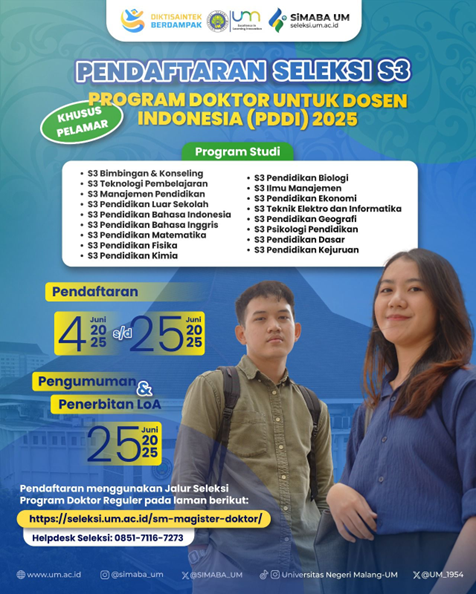
    Starting on June 4th, 2025, you will be able to enroll into one of our Ministry’s distinguished programs, the PDDI (Program Doktor untuk Dosen Indonesia) 2025.

    Beware folks, the scholarship is well selected and has been one of the most acclaimed grants for academic programs. So, be sure to always be as competitive as you can!

    Interested candidates or applicants to any of our departments in Universitas Negeri Malang should click this link (https://seleksi.um.ac.id/sm-magister-doktor/) or contact our dedicated helpdesk to this number (0851 7116 7273).

    And don’t forget another important detail: while you are at it, make sure to always keep visiting our website and social media platforms for relevant and useful updates! Good luck and good hope, people!