
Writing a thesis or academic article in English is often a major hurdle for Indonesian students. Many struggle with the nuances of academic style, proper structure, and the writing strategies needed to meet international publication standards. These challenges frequently lead to delayed graduations and limited contributions to reputable journals.
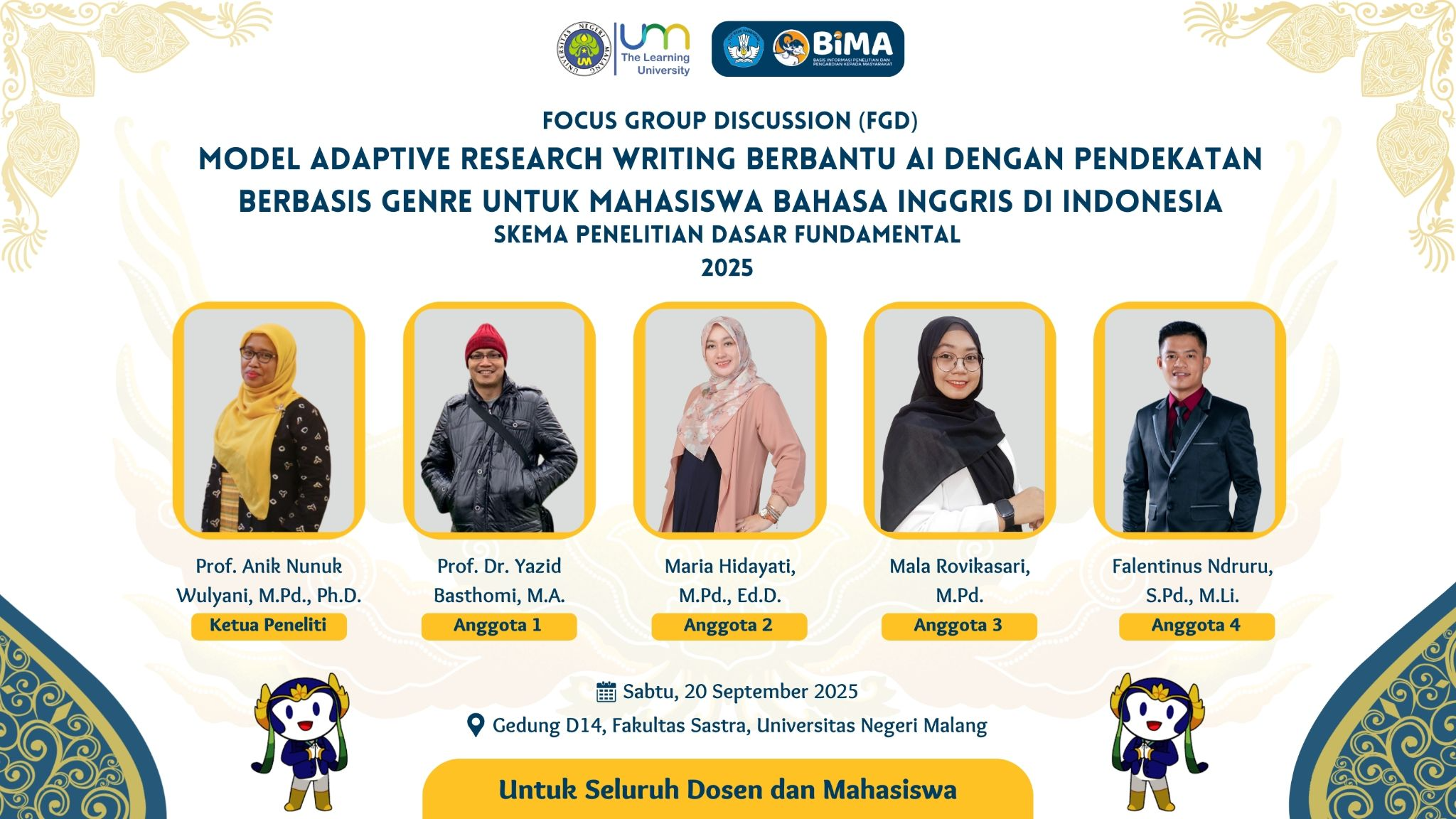
To tackle this problem, a research team from Universitas Negeri Malang (UM) is developing an adaptive, genre-based academic writing model assisted by Artificial Intelligence (AI). The two-year project, led by Professor Anik Nunuk Wulyani, involves eight universities from across the Indonesian archipelago, from Aceh to Papua. The team full-force includes Professor Yazid Basthomi, Maria Hidayati, M.Pd., Ed.D., along with two student-members, Mala Rovikasari, M.Pd. and Falentinus Ndruru, S.Pd., M.Li.
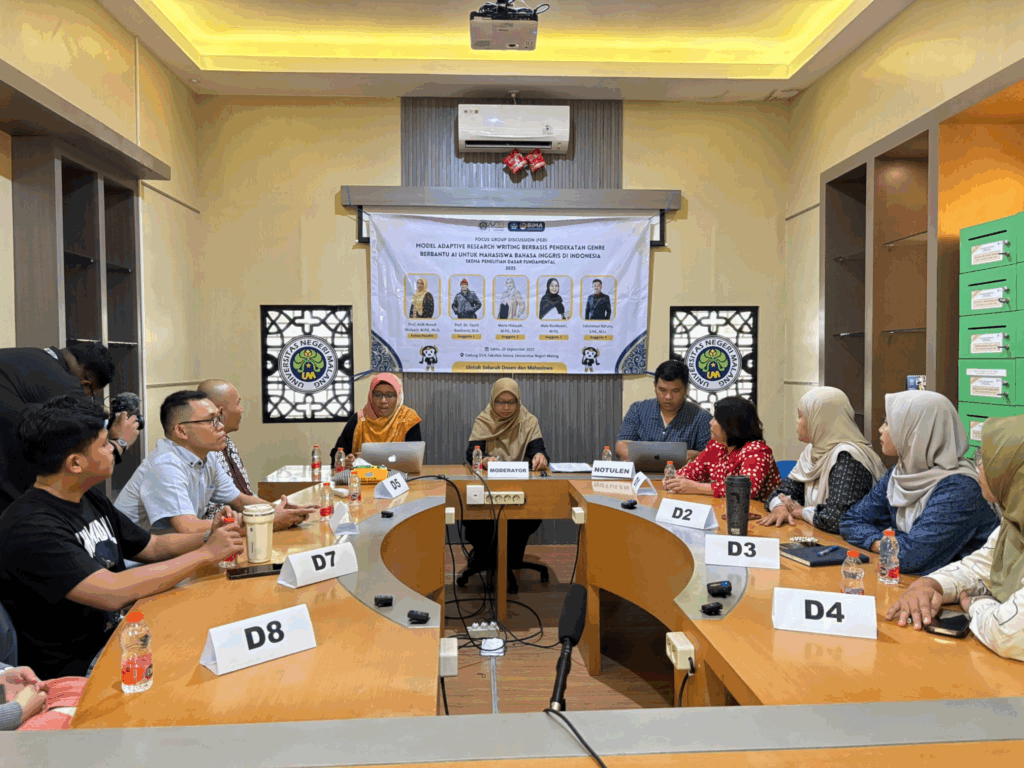
According to Prof. Wulyani, students’ biggest weakness is not just language proficiency, but also a lack of understanding of academic genres—such as how to structure a research introduction, write a literature review, or present findings. “AI enables more personalized learning. Students can receive feedback tailored to their specific weaknesses and needs. This makes the writing process more focused and effective,” she explained.
The research, entitled An AI-Assisted, Genre-Based Adaptive Model for Research Writing in Indonesian English Language Studies, uses an Educational Design Research (EDR) approach, a method that emphasizes gradual model development: starting from needs analysis, prototype design, and expert validation, to real-world testing in classrooms. The expected outcome is an adaptive, AI-based learning model ready for widespread adoption in Indonesian higher education.
In addition to the prototype, the team is targeting publications in reputable international journals (Scopus Q1), international conference proceedings, and a policy brief to provide input for higher education stakeholders.
Furthermore, this initiative aligns with the Sustainable Development Goals (SDGs), specifically SDG 4 (Quality Education), SDG 9 (Industry, Innovation, and Infrastructure), and SDG 17 (Partnerships for the Goals). The cross-university collaboration is a concrete step toward building a more inclusive and innovative educational ecosystem.
“We hope this research will help students graduate on time, improve the quality of academic publications, and strengthen Indonesia’s position in the global academic arena,” added Prof. Wulyani. If successful, this model has the potential to become a breakthrough for national higher education, establishing UM as a pioneer in leveraging AI to boost Indonesia’s academic competitiveness.

Curious readers may visit our professional and national-scale media partners at Kapanlagi and Fimela for additional information and or further updates about the research and results.
Leave a Reply